Nonresidential Construction Spending Declines in November

January 6, 2020 - 3:21pm

Key Takeaways

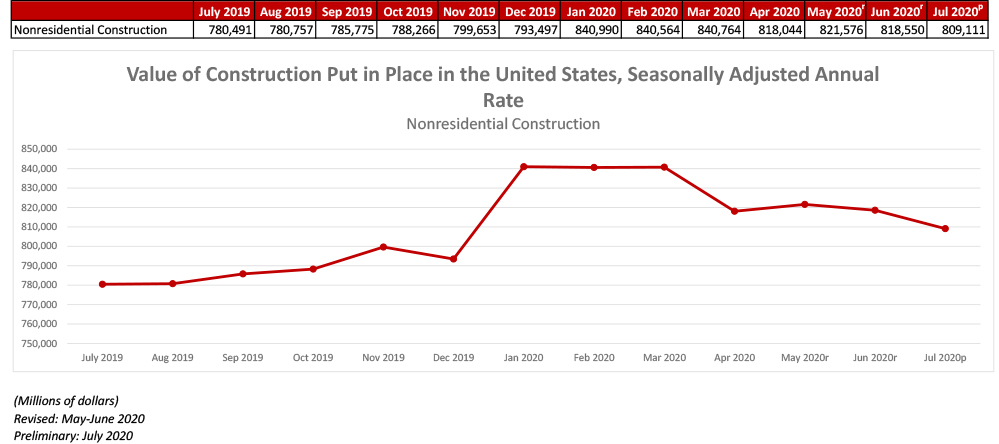
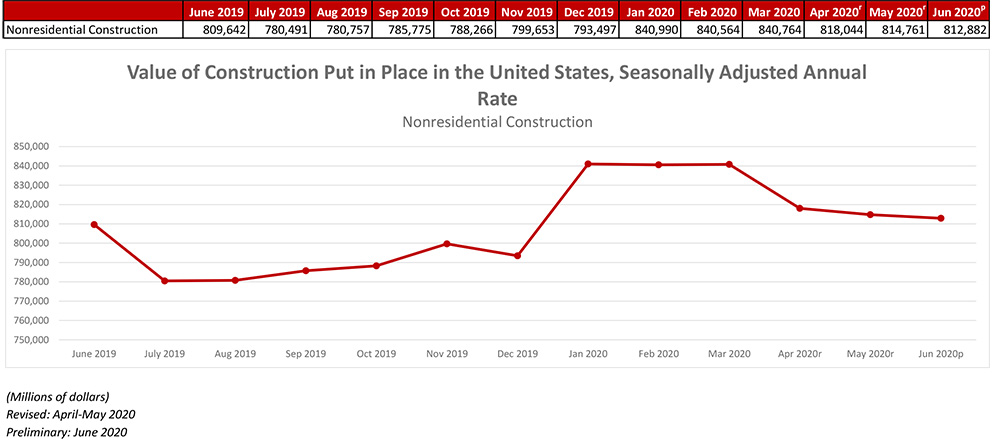
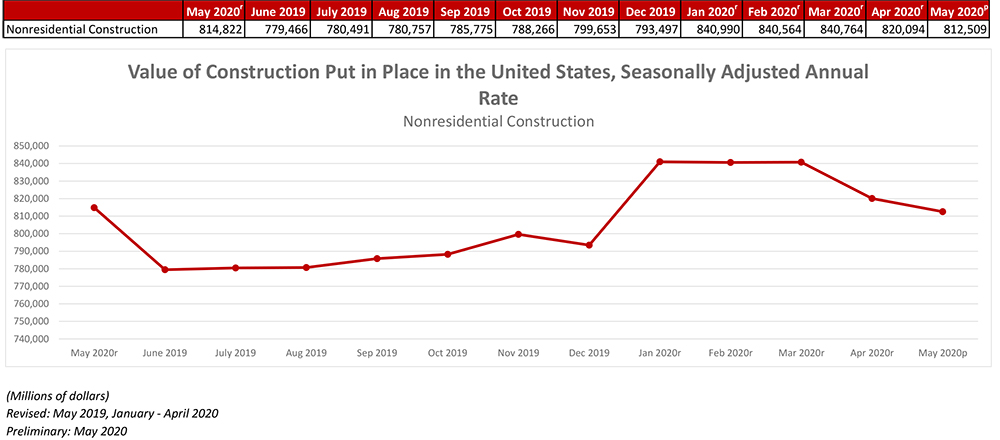
  • Nonresidential construction spending, which totaled $781.1 billion on a seasonally adjusted annual basis in November, declined .3% from October but increased 5.1% year over year.
  • Private nonresidential spending fell 1.2% on a monthly basis and is up by a slight 0.2% compared to the same time last year. Public nonresidential construction spending increased 0.9% in November and is up 12.4% year over year.
  • "After sending out recessionary signals during mid-2019, the economy has rebounded despite lingering uncertainty emanating from many sources, including the Middle East. Through it all, the U.S. economy has remained robust, positioning office and other lagging segments to improve during the months ahead.”

Press Release from Associated Builders and Contractors, Inc.

Nonresidential Construction Spending Falls in October

December 6, 2019 - 4:26pm

Key Takeaways

  • Nonresidential construction spending, which totaled $776.5 billion on a seasonally adjusted annual basis October, fell 0.7% from September but is up 1.4% compared to the same time last year.
  • Private nonresidential spending fell 1.2% on a monthly basis and is down 4.3% compared to the same time last year. Public nonresidential construction spending also declined, falling 0.1% from September. On an annual basis, however, public nonresidential spending is up 10.4%.
  • "Commercial construction is down more than 16% over the past year, which coincides with the fact that 2019 will set a record for store closings in the U.S. as e-commerce continues to gobble up market share. Lodging and office-related construction has also slowed of late, likely because developers have already exhausted many of the best investment opportunities.”

Press Release from Associated Builders and Contractors, Inc.

Nonresidential Construction Employment Rises in November

December 6, 2019 - 4:19pm

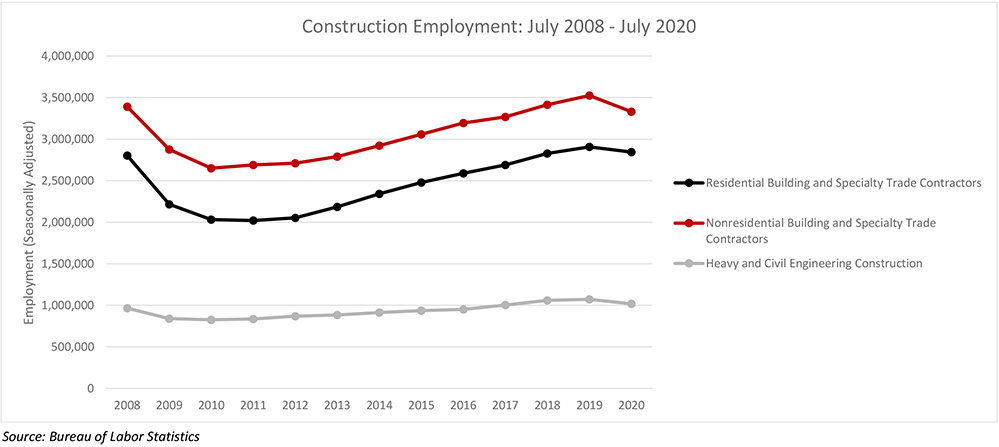
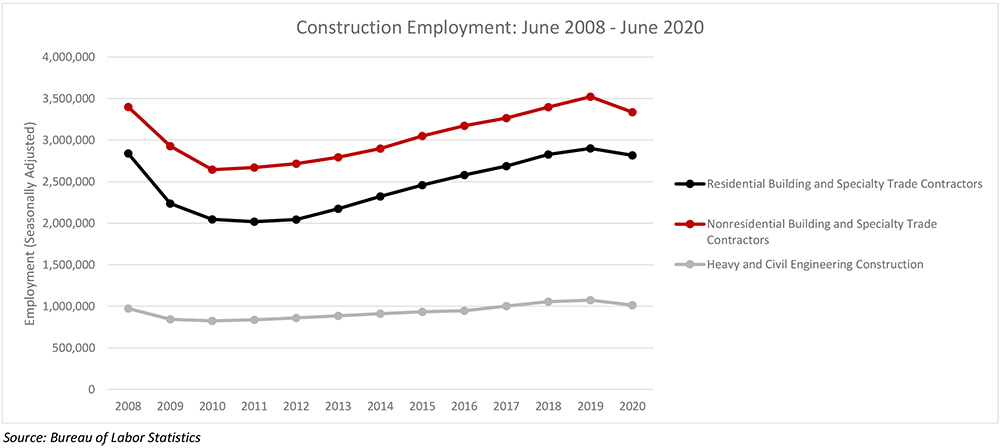
According to data released Friday by the US Bureau of Labor Statistics, the national construction industry added 1,000 net new jobs in November.

Key Takeaways

  • The construction industry added 1,000 net new jobs in November and, on a year-over-year basis, has expanded by 146,000 jobs, an increase of 2%.
  • The construction unemployment rate rose to 4.4% in October, up from 4.0% in September and up .5 percentage points from October 2018.
  • Nonresidential construction employment increased by 1,600 jobs on net in November and is up by 98,600 net jobs over the last 12 months.
  • “Any near-term recessionary fears during the summer have been neatly extinguished. While labor market data tend to be lagging indicators, it is clear that the U.S. economy retains plentiful momentum as it heads toward 2020. Today’s release also suggests that construction firms will continue to wrestle with profound skilled labor shortages as other industries offer plentiful employment opportunities and more construction workers retire.”

Optimize a Workforce with Millennial, Gen X and Baby Boomer Employees

November 4, 2019 - 3:11pm

Article written by By John Fish and appears on ConstructionExec.com.

Solving for X. Most probably recall that simple algebra equation from back in their early school days. But solving for X isn’t about math anymore. It’s about placemaking for Generation X and Millennials—two very different generations that hold the key for businesses to achieve true greatness.

Suffolk Construction expends a lot of time and resources handpicking the “best and brightest” young people to work for the organization—and for good reason. Its leadership has found Millennial employees, born between 1981 and 2000, to be optimistic, confident, social and diverse. They are also adept at change and technologically savvy, an ideal combination for any organization on a quest to innovate, create and challenge the status quo.

Year-End Tax Planning Strategies for Contractors

November 4, 2019 - 3:05pm

Article written by By Jacquelyn Himes and appears on ConstructionExec.com.

There are many tax planning strategies a construction contractor can implement to reduce the company’s tax liability. Now is a good time to review the company’s financial goals, operations and results over the past year. Discuss what was done and how to qualify for tax deductions or credits with a construction accounting specialist.

Accelerating certain expenses and postponing others may help to decrease, or even eliminate, a contractor’s tax liability. It is important to consider the timing of all expenditures at this time of year, including bonus payments, as well as the reporting of income. It might be beneficial to postpone certain expenses and delay receiving income until the new year.

The Tax Cuts and Jobs Act (TCJA) of 2017 significantly changed the tax law. Contractors need to be aware of these changes and plan accordingly. Here are several tax planning opportunities that contractors may qualify for under TCJA.

Nonresidential Construction Adds 10,000 Jobs in October

November 4, 2019 - 2:54pm

According to data released Friday by the US Bureau of Labor Statistics, the national construction industry added 10,000 net new jobs in October.

Key Takeaways

  • The construction industry added 10,000 net new jobs in October and, on a year-over-year basis, has expanded by 148,000 jobs, an increase of 2%.
  • The construction unemployment rate rose to 4% in October, up from 3.2% in September.
  • Nonresidential construction employment increased by 4,000 jobs on net in October and is up 2.1% over the past year.
  • “The expected depletion of the Highway Trust Fund in 2021, however, represents a looming threat to public construction momentum. The implication is that the overall nonresidential construction spending cycle may experience greater turbulence over the next 12 to 18 months, but for now, the data indicate overall positive momentum.”

Project Managers Driving Demand for Better, Faster Construction Data

October 4, 2019 - 10:52am

Article written by Kati Viscaino on the Viewpoint blog

Construction projects today produce a mountain of data. From job costs to materials quantities to equipment usage to labor and production stats, data drives how successful a project will be. The most successful projects — and contractors — are able to accurately collect all available data and analytically dig deep into it to better understand projects. But that’s easier said than done.

Ask virtually any project manager, for instance, and they’ll tell you they’re consistently behind — swamped with work and buried in a mountain of paperwork. Their body of work is judged by four words: “on time” and “on budget.” But if getting there means using a mix of manual processes and outdated, non-connected software systems, then they’re not working as efficiently as they could be.

Nonresidential Construction Employment Rises in September

October 4, 2019 - 10:37am

According to data released today by the US Bureau of Labor Statistics, the national construction industry added 7,000 net new jobs in September.

Key Takeaways

  • The construction industry added 7,000 net new jobs in September and, on a year-over-year basis, has expanded by 156,000 jobs, an increase of 2.1%.
  • The construction unemployment rate stood at 3.2% in September, down 0.9 percentage points from the same time last year. Unemployment across all industries was 3.5% in September, 0.2 percentage points lower than the previous month. This was the lowest recorded rate since December 1969.
  • Nonresidential construction employment increased by 3,800 jobs on net in September and is up by 96,300 net jobs during the last 12 months.
  • "The ongoing declines in various measures of unemployment are consistent with the notion that the average contractor, including subcontractors, will continue to face enormous difficulty recruiting new employees. Many contractors continue to pay for substantial overtime, translating into flat profit margins or worse in the context of still plentiful bidding opportunities."

Nonresidential Construction Spending Declines in August

October 4, 2019 - 10:17am

Key Takeaways

  • Nonresidential construction spending, which totaled $773.8 billion on a seasonally adjusted annual basis for August, declined 0.4% from July but is 0.3% higher than August 2018.
  • Private nonresidential spending fell 1% in August and 2.8% on a yearly basis, following declines in July as well. Public nonresidential spending increased 0.4% on a monthly basis and 4.8% for the year.
  • “All of this is consistent with a slowing economy, especially as measures such as industrial production and capacity utilization remain stagnant.”

Press Release from Associated Builders and Contractors, Inc.

WASHINGTON, Oct. 1—National nonresidential construction spending declined 0.4% in August, according to an Associated Builders and Contractors analysis of U.S. Census Bureau data published today. On a seasonally adjusted annualized basis, spending totaled $773.8 billion, 0.3% higher than in August 2018.

Subscribe to Construction News