Key Takeaways
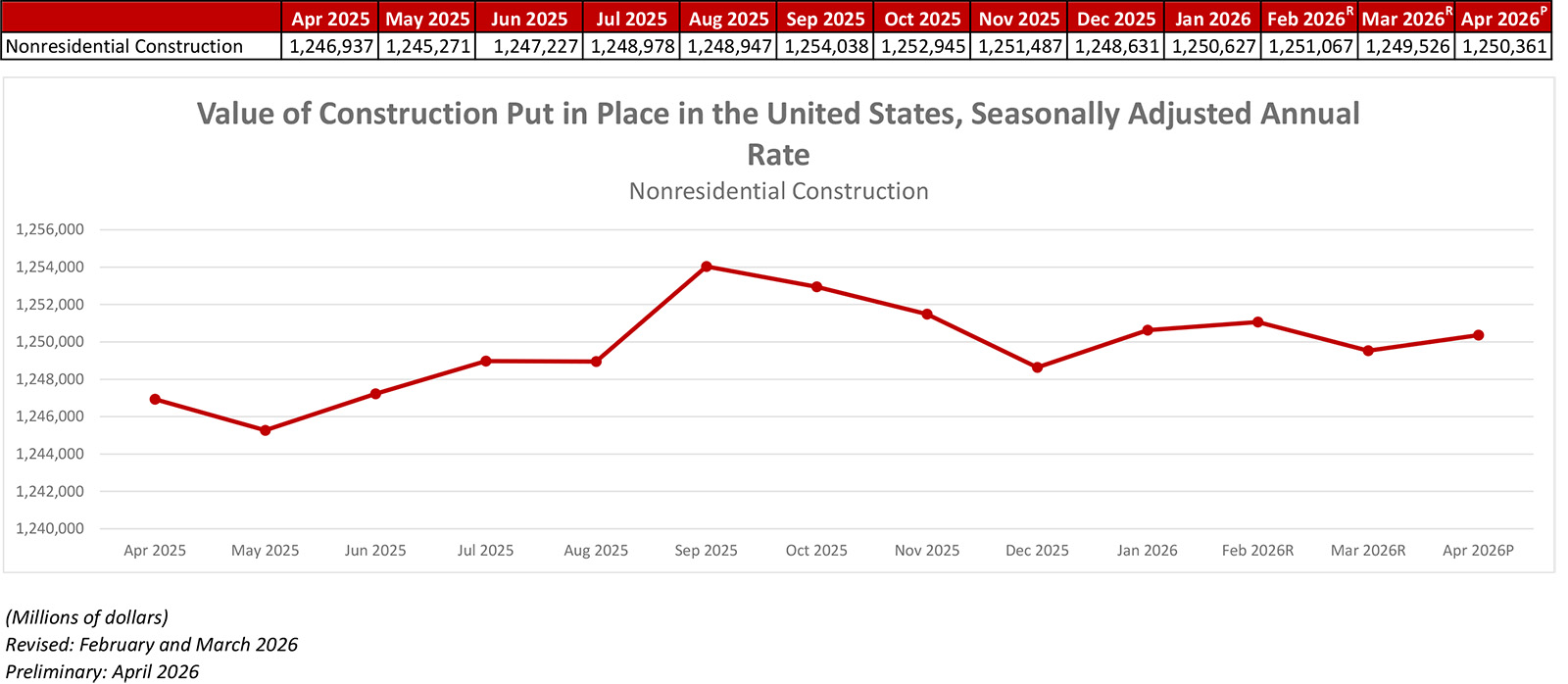
- National nonresidential construction spending increased 0.1% in April
- On a seasonally adjusted annualized basis, nonresidential spending totaled $1.250 trillion for the month.
- "Nonresidential construction spending inched higher in April, but that growth was entirely due to a sizable increase in public sector activity."
Press Release from Associated Builders and Contractors (ABC)
ABC: Nonresidential Construction Spending Grows on Public Sector Strength in April
WASHINGTON, June 1—National nonresidential construction spending increased 0.1% in April, according to an Associated Builders and Contractors analysis of data published today by the U.S. Census Bureau. On a seasonally adjusted annualized basis, nonresidential spending totaled $1.250 trillion.
Spending was up on a monthly basis in 10 of the 16 nonresidential subcategories. Private nonresidential spending was down 0.2%, while public nonresidential construction spending was up 0.4% in April.
Spending on data centers, which is included in the office category, increased another 1.9% in April, rising to a seasonally adjusted annual rate of $50.7 billion, and is up 28.1% over the past year.
“Nonresidential construction spending inched higher in April, but that growth was entirely due to a sizable increase in public sector activity,” said ABC Chief Economist Anirban Basu. “Private nonresidential construction spending fell for the seventh consecutive month and is down nearly 8% from December 2023’s all-time high. While much of the segment’s recent weakness is attributable to the rapid decline in CHIPS Act-incentivized manufacturing megaprojects, private sector construction momentum has been difficult to find outside of the still-ascendant data center segment.
“Those data center projects have buoyed the ABC Construction Backlog Indicator and kept ABC members confident about their outlooks, at least on the whole,” said Basu. “While that particular tailwind will persist for some time, rising materials prices and a lack of momentum in many commercial segments may eventually weigh on contractor sentiment.”
Press Release from Associated General Contractors of America (AGC)
Contracting Officials Cite Vital Role of Highway Spending in Supporting Economic Growth Nationwide As They Note Total Nonresidential Construction Spending Has Risen Only When Road Projects Increase
Construction spending increased 0.4 percent from March to April and 0.9 percent over 12 months, according to an analysis by the Associated General Contractors of America of a new government report released today. Association officials urged Congress and the White House to pass a new highway and transportation funding bill before the current law expires in September in order to keep construction spending and the economy on a growth path.
“Highway construction has been a major contributor to total nonresidential spending,” said Ken Simonson, the association’s chief economist. “For the past several months, total spending has increased only when there was a rise in year over year highway construction activity.”
Construction spending totaled $2.172 trillion at a seasonally adjusted annual rate in April. That figure is 0.4 percent above the revised March rate and 0.9 percent higher than the April 2025 level.
Public construction spending increased 0.4 percent in April and was 3.7 percent higher than one year earlier. The largest public category, highway and street construction, increased by 0.4 percent from March and 3.9 percent over the past year. That segment alone accounts for more than a quarter of total public construction and contributes to economic growth through improved travel times for people and freight, as well as supporting industries that supply materials and equipment for the projects.
Private residential construction increased 0.8 percent for the month, and 1.7 percent compared to April 2025. Single-family construction increased 1.4 percent from March but remained 2.9 percent below year-ago levels. Multifamily construction slipped 0.3 percent for the month but was 1.1 percent higher than a year earlier.
Private nonresidential construction declined 0.2 percent in April and fell 2.1 percent compared to April 2025. Manufacturing construction continued to weaken sharply, dropping 18.5 percent over the past 12 months. The next-largest private category, electric power and oil and gas-related construction, rose 0.6 percent for the month and 6.0 percent year over year. Commercial construction slipped by 0.7 percent from March but rose 1.5 percent from April 2025, with warehouse construction down 1.6 percent year over year and retail construction up 5.9 percent. Private office construction, including data centers, climbed 1.0 percent for the month and 9.4 percent over 12 months, with data centers jumping 28 percent over 12 months while actual offices fell 5.5 percent.
Association officials noted that federal funding for highway and transit construction supports projects in every state, improving travel times for individuals and freight while improving safety. They urged Congress to complete work on renewing the federal legislation before the current law expires on Sept. 30.
“Any lapse in funding these vital projects would force contractors to sideline construction workers and delay purchasing needed equipment and materials,” said Jeffrey D. Shoaf, the association’s chief executive officer. “That would be a significant setback for the economy overall, and especially for millions of drivers, transit riders, and businesses that rely on good roads, as well as for construction workers and their families.”