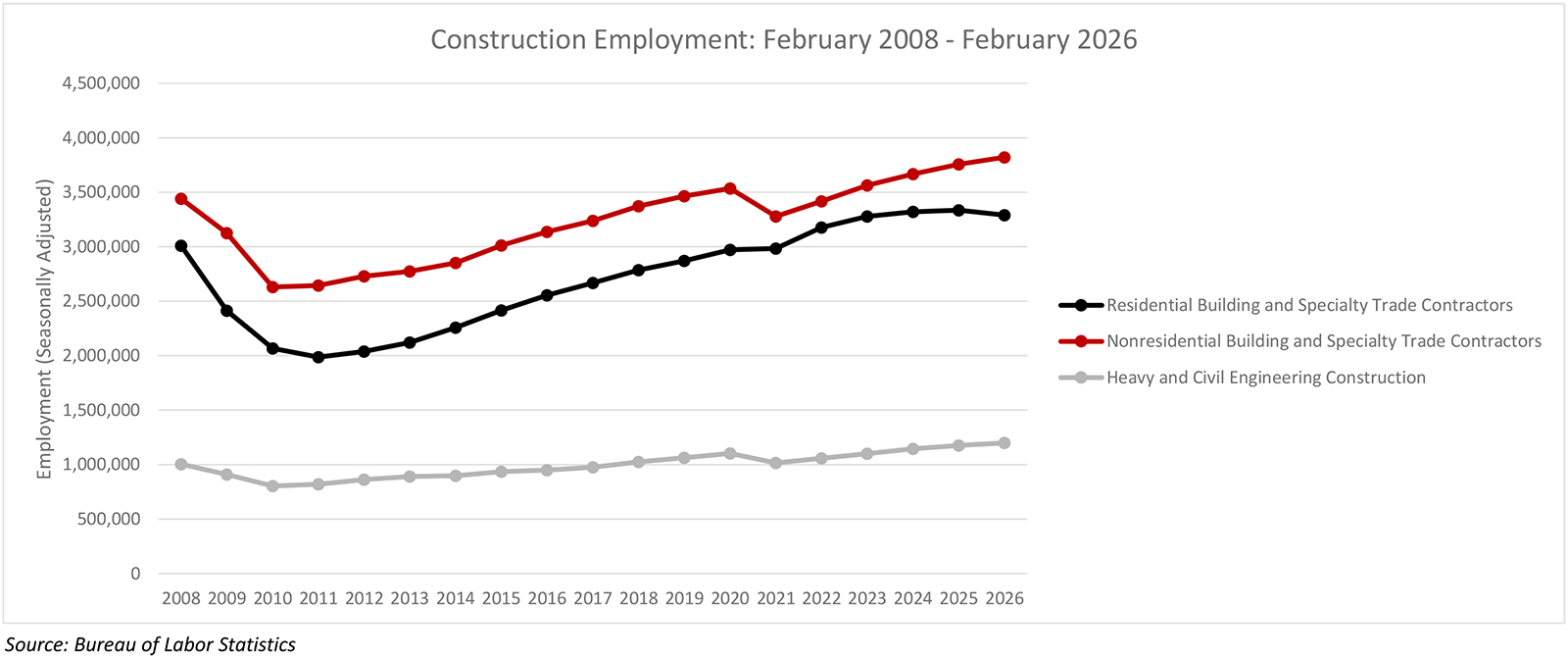
According to data released today by the US Bureau of Labor Statistics:
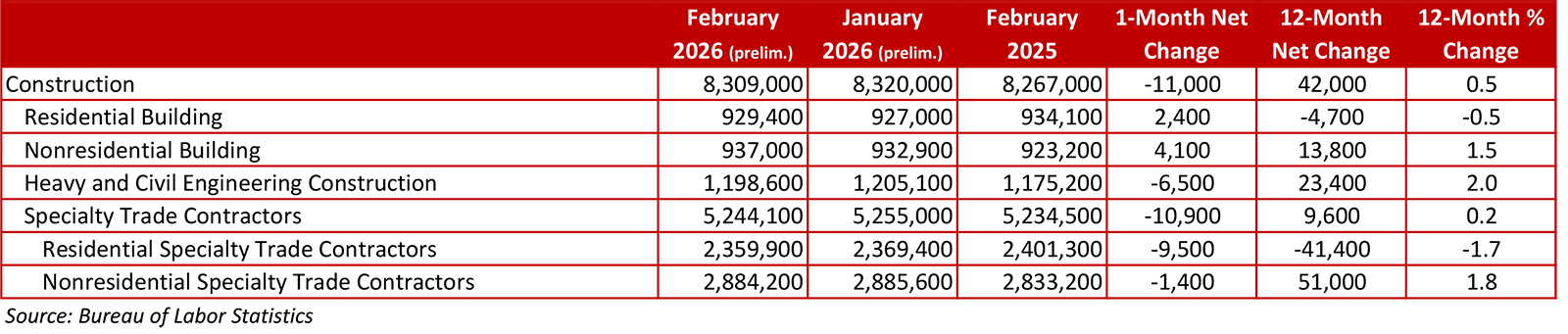
- The construction industry lost 11,000 jobs on net in February. On a year-over-year basis, industry employment grew by 42,000 jobs, an increase of 0.5%.
- Nonresidential construction employment decreased by 3,800 positions on net, with losses in 2 of the 3 subcategories.
- "Both the residential and nonresidential segments lost jobs for the month, adding to a recent string of downbeat industry data releases ... With the conflict in Iran adding to trade policy-related uncertainty and crude oil prices well above $80 per barrel, the industry’s outlook remains downbeat through the first few months of 2026."
Press Release from Associated Builders and Contractors, Inc (ABC)
ABC: Construction Loses 11,000 Jobs in February
WASHINGTON, Mar. 6—The construction industry lost 11,000 jobs on net in February, according to an Associated Builders and Contractors analysis of data released today by the U.S. Bureau of Labor Statistics. On a year-over-year basis, industry employment has grown by 42,000 jobs, an increase of 0.5%.
Nonresidential construction employment decreased by 3,800 positions, with losses in 2 of the 3 subcategories. Heavy and civil engineering lost 6,500 jobs and nonresidential specialty trade lost 1,400 positions, while nonresidential building added 4,100 jobs in February.
The construction unemployment rate was 6.9% in February. Unemployment across all industries rose to 4.4% and is 0.2 percentage points higher than one year ago.
“Construction employment shrank again in February and has now declined in 8 of the past 11 months,” said ABC Chief Economist Anirban Basu. “Both the residential and nonresidential segments lost jobs for the month, adding to a recent string of downbeat industry data releases; construction spending has been in decline for several quarters, and ABC’s Construction Backlog Indicator fell to a four-year low in January. With the conflict in Iran adding to trade policy-related uncertainty and crude oil prices well above $80 per barrel, the industry’s outlook remains downbeat through the first few months of 2026.”