Key Takeaways
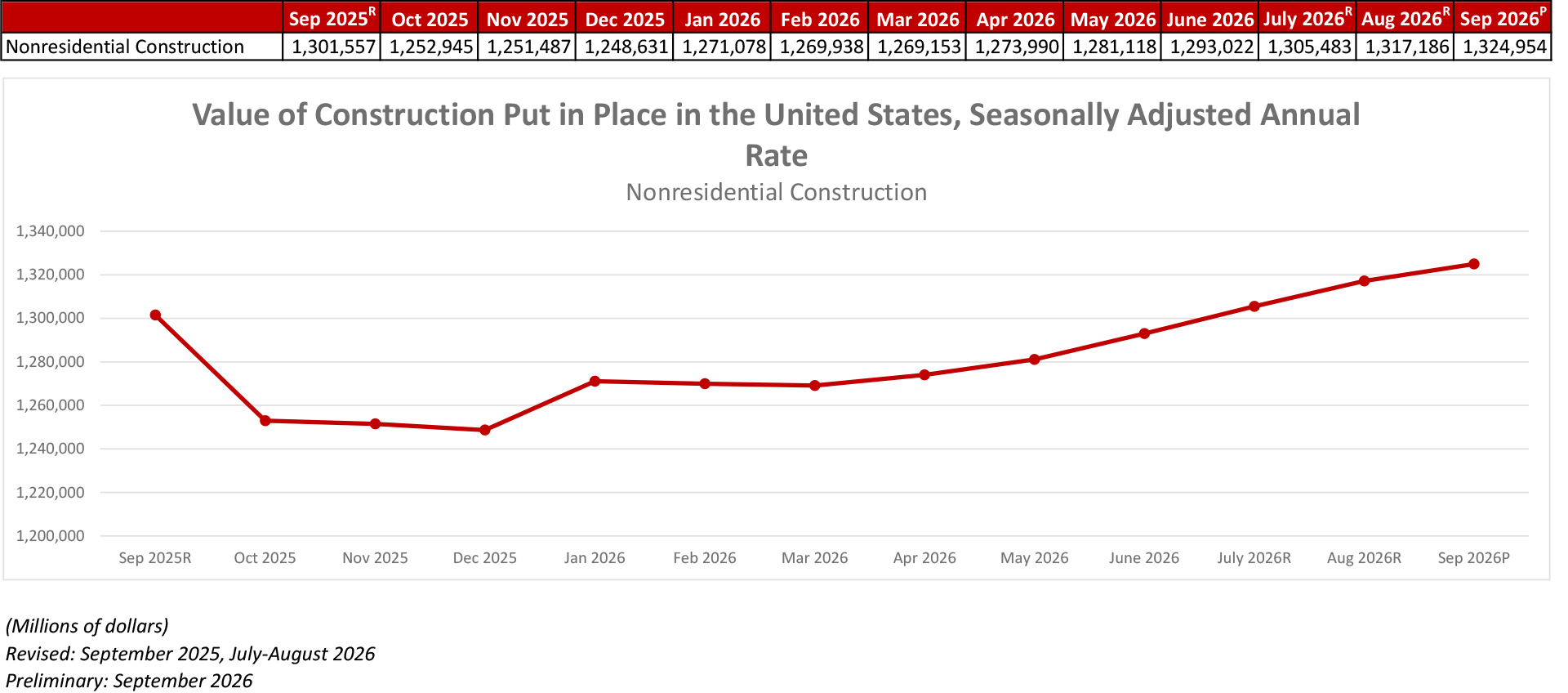
- National nonresidential construction spending increased 0.6% in September.
- On a seasonally adjusted annualized basis, nonresidential spending totaled $1.325 trillion for the month.
- "It’s increasingly difficult to contextualize the speed of the data center boom; spending in the category jumped another 8.6% in September and has grown at a 217% annualized rate since May."
Press Release from Associated Builders and Contractors (ABC)
ABC: Data Centers Continue to Drive Nonresidential Spending Higher in September
WASHINGTON, Nov. 2—National nonresidential construction spending increased 0.6% in September, according to an Associated Builders and Contractors analysis of data published today by the U.S. Census Bureau. On a seasonally adjusted annualized basis, nonresidential spending totaled $1.325 trillion.
Spending was up on a monthly basis in 8 of the 16 nonresidential subcategories. Private nonresidential spending was up 1.1%, while public nonresidential construction spending was down 0.1% in September.
“Nonresidential construction spending grew for the sixth consecutive month in September,” said ABC Chief Economist Anirban Basu. “As has been the case for several months, data centers accounted for virtually all of that increase. Excluding data centers and the closely related power category, nonresidential spending actually fell in September. It’s increasingly difficult to contextualize the speed of the data center boom; spending in the category jumped another 8.6% in September and has grown at a 217% annualized rate since May.
“Given the recent rise in treasury yields and ongoing materials price escalation, momentum will remain narrowly concentrated in artificial intelligence-related segments over the next several months,” said Basu. “While contractors remain busy in the aggregate, according to ABC’s Construction Backlog Indicator, current market dynamics will continue to favor larger contractors who are far more likely to be involved in data center and power projects.”
Press Release from Associated General Contractors of America (AGC)
Association Issues Construction Inflation Alert to Help Project Owners, Government Officials Understand How Higher Prices, Supply-Chain Bottlenecks, Tight Labor Market Affect Contractors and Their Workers
Construction spending slumped 1.9% from August to September and 2.7% from the September 2025 level, according to an analysis by the Associated General Contractors of America of a new government report released today. The association issued a new bulletin detailing how higher costs, supply-chain problems and a tight labor market add to the risk of further declines.
“Surging demand for data centers and power projects is masking cutbacks in other investments while adding to the strains on construction supply chains and costs caused by high tariffs and international conflicts," said Ken Simonson, the association’s chief economist. “The association has just posted a new edition of its Construction Inflation Alert. The document is designed to help project owners, government officials and the public understand how these challenges and a tight labor market are affecting contractors and their workers.”
Construction spending totaled $2.19 trillion at a seasonally adjusted annual rate in September. That figure is 1.9% below the downwardly revised August rate and 2.7% below the September 2025 level.
Private nonresidential construction spending increased 1.1% in September and 2.3% compared with September 2025. Two project types accounted for the gains, Simonson said, based on an analysis of detailed historical data: data centers and electric power. Spending on data center construction soared 8.6% for the month and 90% year-over-year, while private electric power investment climbed 1.3% from August and 14% from September 2025. All other private categories combined fell 0.2% for the month and 7.8% over 12 months.
Private residential construction was similarly unbalanced, the economist noted. Private residential slipped 5.5% for the month and 8.9% from the September 2025 level. But the monthly decline was limited to the volatile residential improvements segment, which tumbled 13% from August and 18% year-over-year. Single-family construction was unchanged from August but was down 2.4% year-over-year. Multifamily construction inched up 0.1% for the month but remained 0.2% lower than one year earlier.
Public construction spending dipped 0.1% from August but rose 1.0% year-over-year. The largest public category, highway and street construction, declined 0.3% from August but remained 3.5% higher than in September 2025. Public educational spending was flat in September and fell 1.4% over 12 months. Public outlays for transportation facilities such as airports rose 0.4% for the month and 2.6% from a year earlier. Spending on sewage and waste disposal structures climbed 0.6% from August but fell 1.5% year-over-year.
Association officials urged policy makers in Washington to address three issues that are dragging down several types of investment. They said officials should promptly enact a new highway and transit funding bill, lower high tariffs and provide a mechanism for contractors to add to the skilled labor supply.
“Our Construction Inflation Alert lays out the challenges contractors are facing and suggests ways to cope,” said Jeffrey D. Shoaf, the association’s chief executive officer. “But it’s up to officials in Washington to ease many of these problems by passing needed legislation and removing barriers to materials and labor supply.”