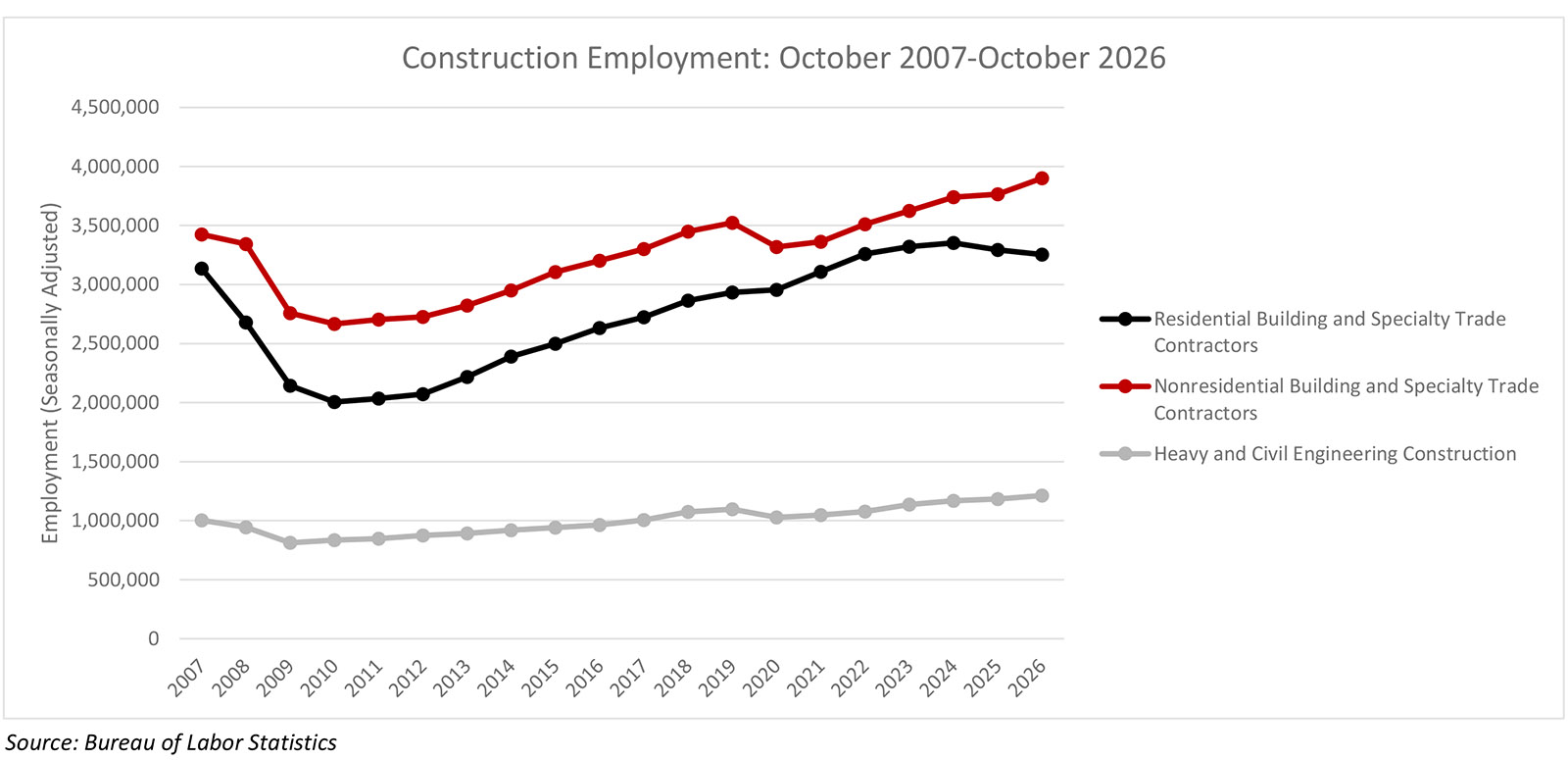
According to data released today by the US Bureau of Labor Statistics:
- The construction industry lost 3,000 jobs on net in October. On a year-over-year basis, industry employment grew by 124,000 jobs, an increase of 1.5%.
- Nonresidential construction employment increased by 13,300 positions on net, with gains in all 3 subcategories.
- "The construction industry lost jobs for the first time since February. As has been the case, however, job losses continued to be entirely concentrated on the residential side of the industry. Nonresidential construction employment, buoyed by the ongoing data center boom, expanded yet again and has grown more than twice as fast as economywide employment over the past year."
Press Release from Associated Builders and Contractors, Inc (ABC)
ABC: Nonresidential Construction Adds 13,300 Jobs in October
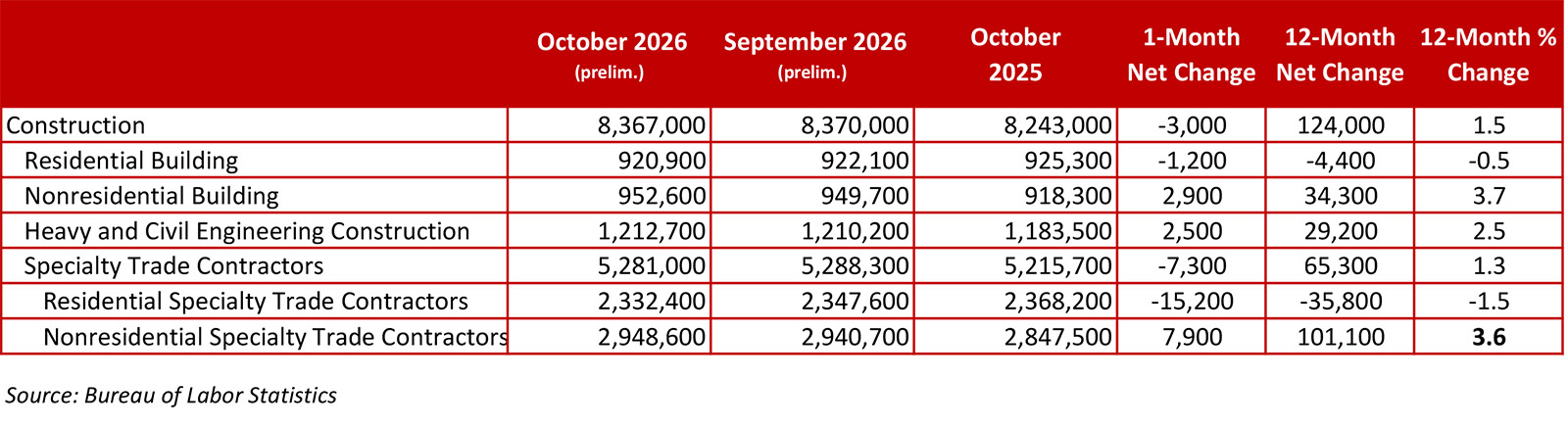
WASHINGTON, Nov. 6—The construction industry lost 3,000 jobs on net in October, according to an Associated Builders and Contractors analysis of data released today by the U.S. Bureau of Labor Statistics. On a year-over-year basis, industry employment has grown by 124,000 jobs, an increase of 1.5%.
Nonresidential construction employment increased by 13,300 positions, with gains in all three subcategories. Nonresidential specialty trade added the most jobs, increasing by 7,900 positions, while nonresidential building and heavy and civil engineering added 2,900 and 2,500 jobs, respectively, in October.
The construction unemployment rate was 3.6% last month. Unemployment across all industries decreased to 4.1%.
“The construction industry lost jobs for the first time since February,” said ABC Chief Economist Anirban Basu. “As has been the case, however, job losses continued to be entirely concentrated on the residential side of the industry. Nonresidential construction employment, buoyed by the ongoing data center boom, expanded yet again and has grown more than twice as fast as economywide employment over the past year."
“Nonresidential payrolls should continue to expand in the coming months; nearly 50% of contractors expect to increase their staffing levels over the next six months, according to ABC’s Construction Confidence Index, while fewer than 12% expect to cut workers,” said Basu.
“The October jobs report provided yet more evidence of reemerging construction worker shortages,” said Basu. “The industry’s unemployment rate of 3.6% matches 2018 as the lowest October level since the turn of the century, and this labor market tightness is causing rapid wage escalation. Average hourly earnings for construction employees grew at the fastest monthly pace in over three years in October and are now up 4.7% year over year, significantly more than the 3.1% average wage growth across all industries.”
Press Release from Associated General Contractors of America (AGC)
Employment Accelerates Among Nonresidential Contractors, While Homebuilders Shrink Headcount; Association Urges Policy Makers to Act Promptly to Expand Supply of Needed Workers, Keep Highway Funds Flowing
Construction employment stalled last month as the industry’s unemployment rate tied a record low for October, despite wage increases that outpaced other sectors, according to an analysis by the Associated General Contractors of America of new government data released today. Association officials urged policy makers to create a pathway for contractors to hire more essential workers and to ensure continuation of funding for needed highway and transit improvements.
“Nonresidential contractors are adding employees and raising hourly pay at rates far exceeding the broader economy,” said Ken Simonson, the association’s chief economist. “But continuing those gains will be difficult unless they have a chance to bring in workers with appropriate experience and training.”
Construction employment totaled 8,367,000 in October. That was 3,000 less than the upwardly revised September figure but 124,000 or 1.5% higher than a year earlier. The year-over-year gain far outpaced the 0.6% increase in total nonfarm payroll employment since October 2025.
Nonresidential construction firms accounted for all of the industry’s job gains, as they added 13,300 employees for the month and 164,600 or 3.3% over the past year. Employment at residential builders and subcontractors combined declined by 16,400 workers in October and 40,200 (-1.2%) over 12 months.
All categories of nonresidential construction added employees in October. Nonresidential building firms added 2,900 positions for the month and 34,300 (3.7%) since October 2025. Nonresidential specialty trade contractors added 7,900 employees for the month and 101,100 (3.6%) over 12 months. Heavy and civil engineering construction employment increased by 2,500 positions in October and 29,200 (2.5%) over the year.
Average hourly earnings for production and nonsupervisory employees in construction, which covers most onsite craft workers as well as many office staff, increased to $39.70 per hour in October. That figure is 21.2% higher than the $32.75 average for all private-sector production employees. Construction pay rose 5.2% over the past year, compared with a 3.3% gain for production workers in the overall private-sector.
The number of people actively looking for work who had recent construction experience totaled 363,000 last month, the lowest October figure since 2018. The unemployment rate among these jobseekers fell to 3.6%, not seasonally adjusted, tying the 2018 rate as the lowest for October in the 27-year history of the series. The low unemployment numbers indicate why many contractors are struggling to fill open positions.
Association officials said policy makers need to act promptly to ensure continued growth in high-paying construction jobs. They called for increased funding for career-building education and training programs and creating a means for contractors to sponsor qualified workers from outside the U.S. And they urged lawmakers in Washington to pass a new highway and transit funding bill before federal money runs out in December.
“Contractors are eager to hire more workers,” said Jeffrey D. Shoaf, the chief executive officer of the Associated General Contractors of America. “That requires policy makers to expand training opportunities, pursue sensible immigration reforms and keep funds flowing to support expansion and modernization of highways and transit systems around the country.”