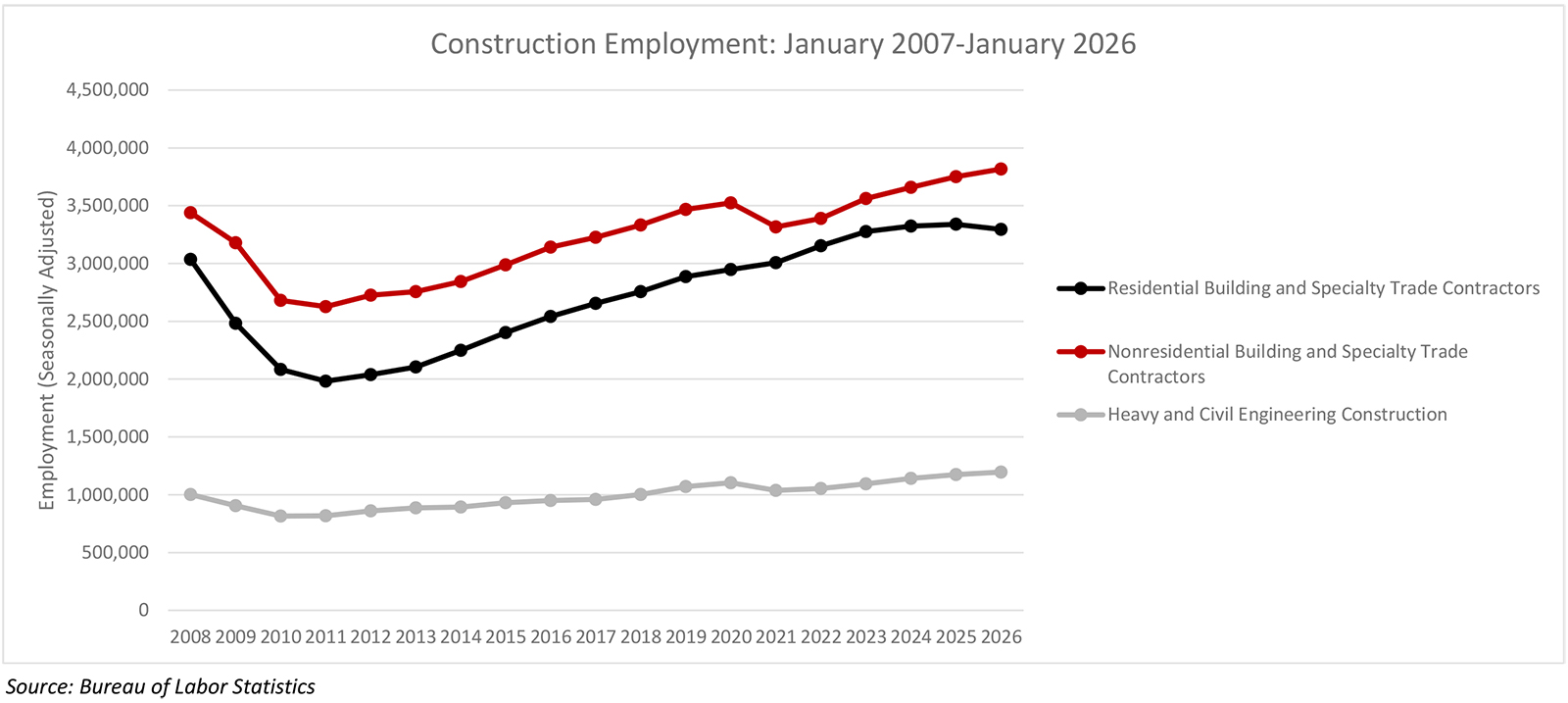
According to data released yesterday by the US Bureau of Labor Statistics:
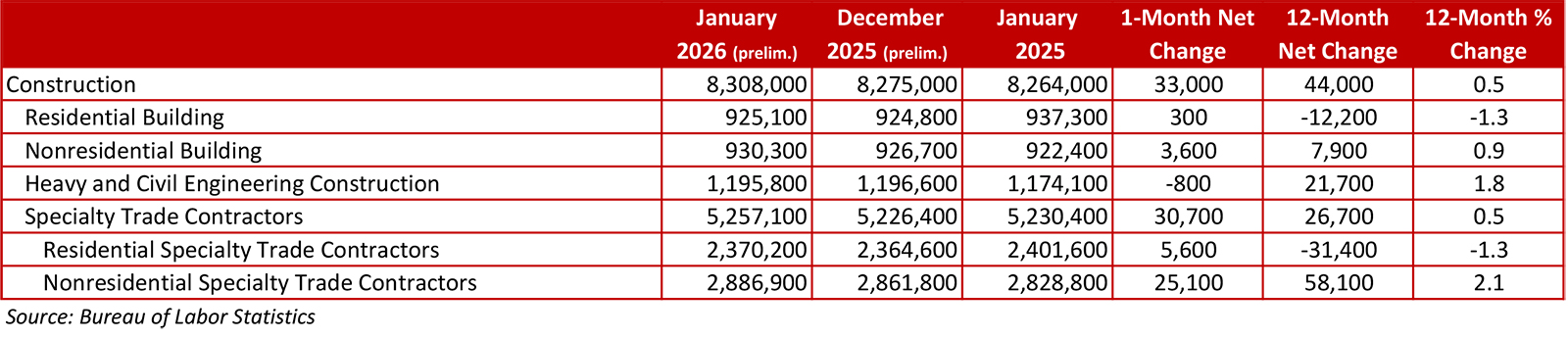
- The construction industry added 33,000 jobs on net in January. On a year-over-year basis, industry employment grew by 44,000 jobs, an increase of 0.5%.
- Nonresidential construction employment increased by 27,900 positions on net, with gains in 2 of the 3 subcategories.
- "The construction industry, much like the broader labor market, rebounded in January. While that’s a welcome development, the industry lost 1,000 jobs in 2025, the first calendar year decline since 2020 and 2010 before that. Much of the industry’s weakness is concentrated in the residential segment, where employment has declined by 43,600 jobs over the past year."
Press Release from Associated Builders and Contractors, Inc (ABC)
ABC: Nonresidential Construction Adds Solid 27,900 Jobs in January
WASHINGTON, Feb. 11—The construction industry added 33,000 jobs on net in January, according to an Associated Builders and Contractors analysis of data released today by the U.S. Bureau of Labor Statistics. On a year-over-year basis, industry employment has grown by 44,000 jobs, an increase of 0.5%./p>
Nonresidential construction employment expanded by 27,900 positions, with gains in 2 of the 3 subcategories. Nonresidential specialty trade added 25,100 jobs, while nonresidential building added 3,600 new positions. Heavy and civil engineering lost 800 jobs in January./p>
The construction unemployment rate was 6.9% in January. Unemployment across all industries decreased to 4.3% and is 0.3 percentage points higher than one year ago./p>
“The construction industry, much like the broader labor market, rebounded in January,” said ABC Chief Economist Anirban Basu. “While that’s a welcome development, the industry lost 1,000 jobs in 2025, the first calendar year decline since 2020 and 2010 before that. Much of the industry’s weakness is concentrated in the residential segment, where employment has declined by 43,600 jobs over the past year./p>
“Despite the lack of job growth in 2025, the industry’s unemployment rate is only modestly higher than one-year ago,” said Basu. “That dynamic at least partially stems from immigration enforcement and the downward pressure it has put on the industry’s labor supply. Neither last year’s weak employment growth nor current labor force dynamics have weighed on contractor confidence, with ABC members still upbeat about both their sales and staffing levels over the next six months, according to ABC’s Construction Confidence Index.”
Press Release from Associated General Contractors of America (AGC)
Construction Employment Increased By 33,000 In January As Nonresidential Hiring Drives Modest Growth
January Gains Concentrated in Nonresidential Sectors as Uncertainty Over Federal Infrastructure Funding Clouds 2026 Outlook
Construction employment increased by 33,000 jobs in January, with gains concentrated in nonresidential construction, according to an analysis of new government data released today by the Associated General Contractors of America. While January hiring was stronger than expected, contractors remain cautious about prospects for sustained growth in 2026.
“It’s encouraging to see solid construction job gains in January after a year of uneven employment,” said Ken Simonson, the association’s chief economist. “But those gains will fade later this year unless policymakers provide greater clarity and stability for infrastructure and energy investment.”
Total construction employment reached 8,308,000 in January, seasonally adjusted, an increase of 33,000 from December. Over the past 12 months, the industry has added 44,000 jobs, a gain of 0.5 percent, outpacing the 0.2 percent increase in total nonfarm payroll employment.
Nearly all of January’s growth occurred in nonresidential construction, which added 27,900 jobs for the month. Within that category, nonresidential specialty trade contractors led hiring with an increase of 25,100 positions, while nonresidential building contractors added 3,600 jobs. Employment in heavy and civil engineering construction was essentially flat, slipping by 800 positions.
Residential construction employment edged up only slightly in January, gaining 5,900 jobs. That increase was driven by residential specialty trade contractors, which added 5,600 positions, while residential building employment was essentially unchanged, adding 300 jobs. Despite the modest monthly uptick, residential employment remains below year-ago levels.
Average hourly earnings for production and nonsupervisory employees in construction—including most onsite craft workers and many office staff—rose to $38.26 in January, an increase of 4.7 percent over the past year. The unemployment rate among workers with recent construction experience climbed to 6.9 percent in January, up from 5.0 percent in December and higher than the 4.6 percent national unemployment rate (not seasonally adjusted). While construction unemployment normally rises in winter months, the sharp increase indicates that job opportunities are still inconsistent in many parts of the industry.
Association officials noted that January’s hiring gains could prove temporary without clearer federal direction on long-term infrastructure funding. With the current federal-aid surface transportation program set to expire on September 30, uncertainty over future investment is already weighing on many contractors’ hiring and bidding decisions.
“Contractors need confidence that infrastructure programs will remain stable and predictable before they can expand payrolls and commit to new projects,” said Jeffrey D. Shoaf, the association’s chief executive officer. “To sustain construction employment, it is critical that Congress and the administration move quickly to enact a new surface transportation bill and provide the long-term funding certainty our industry depends on.”